 How-to
How Often Should You Clear Fence Lines? A Practical Guide
Last Updated: November 11, 2026
Quick Summary
Most fence lines benefit from one full pass a year, with a seasonal walk-through in between. How often you clear fence lines depends on vegetation: grass and weeds need 2-3 passes per year, vines and briars every 3-4 months, small saplings once a year, and woody trees every 2-3 years.
- Inspect each season and spot-clear anything touching the wire or blocking access.
- Save the full clearing pass for late winter unless fence damage forces your hand earlier.
- Vines need a pass roughly every 3-4 months during the growing season.
- Shut off the electric fence charger before cutting anywhere near the wire.
- Clear both sides of the fence so neighbor-side brush doesn't seed your line.
Table of Contents
- How Often Should You Clear Fence Lines? The Baseline Schedule
- The Best Time of Year to Clear Brush and Fence Rows
- Fence Line Clearing Equipment for the Job
- How to Keep Fence Lines Clear Between Full Clearings
- Frequently Asked Questions
How Often Should You Clear Fence Lines? The Baseline Schedule
Most fence lines benefit from one full pass a year, with a seasonal walk-through in between. That annual pass keeps brush from swallowing your boundary and stops small saplings from becoming trees you can't cut by hand. The real interval depends on what's growing and what fence you're protecting. If you're weighing how often to schedule each pass, you can estimate how long fence line clearing takes before committing to a frequency.
| Vegetation Type | Growth Rate | Clear How Often |
|---|---|---|
| Grass and weeds | Fast | 2-3 times per year |
| Vines and briars | Fast | Every 3-4 months |
| Small saplings | Moderate | Once a year |
| Woody trees | Slow | Every 2-3 years |
A decision guide: inspect, spot-clear, or full clearing
Walk the line and ask three questions:
- Is vegetation touching the wire or rails? If yes, spot-clear now. Contact holds moisture against metal and wood, accelerating rust and rot, and on electric fence it can ground out the charge.
- Can you walk the full line without ducking or pushing through? If access is blocked, you've crossed into a clearing job.
- Is there any sign of fence damage, leaning posts, sagging wire, chewed or rubbed wood? Do a full clearing pass and inspect the structure.
Inspect each season and spot-clear anything that fails those checks. Save the full clearing for late winter unless damage forces your hand earlier.
How fence material changes the schedule
- Wire and woven wire: vines climbing and saplings growing into the mesh are the main risks. Vines need a tight interval, roughly every 3-4 months during the growing season, because once they weave into the wire, removal can mean cutting the fence or pulling it apart.
- Wood posts and rails: vegetation holds moisture against wood and speeds rot at the ground line. Keep grass and weeds trimmed back from post bases and check each base during your seasonal walk.
- Electric fence: tall grass and touching branches bleed voltage. A mid-summer trim is usually necessary even when the rest of the line looks fine.
What changes the baseline
Rainfall and growing season drive the real interval. In a wet year, vines and briars may need a pass every 2-3 months instead of every 3-4; in a dry year, the annual pass alone may suffice. Pasture fence that livestock rub against needs more frequent inspection than an untouched boundary fence, and a line bordered by mature trees always needs more sapling work.
Want the step-by-step method for a fence line that's already gone wild? Our guide on clearing overgrown fence lines walks through it.
The Best Time of Year to Clear Brush and Fence Rows
Late winter is often considered a good time to clear brush in many regions. Vegetation is dormant, the ground is firm, and you can see the fence structure without leaves in the way. Cutting now also means less regrowth when spring hits.
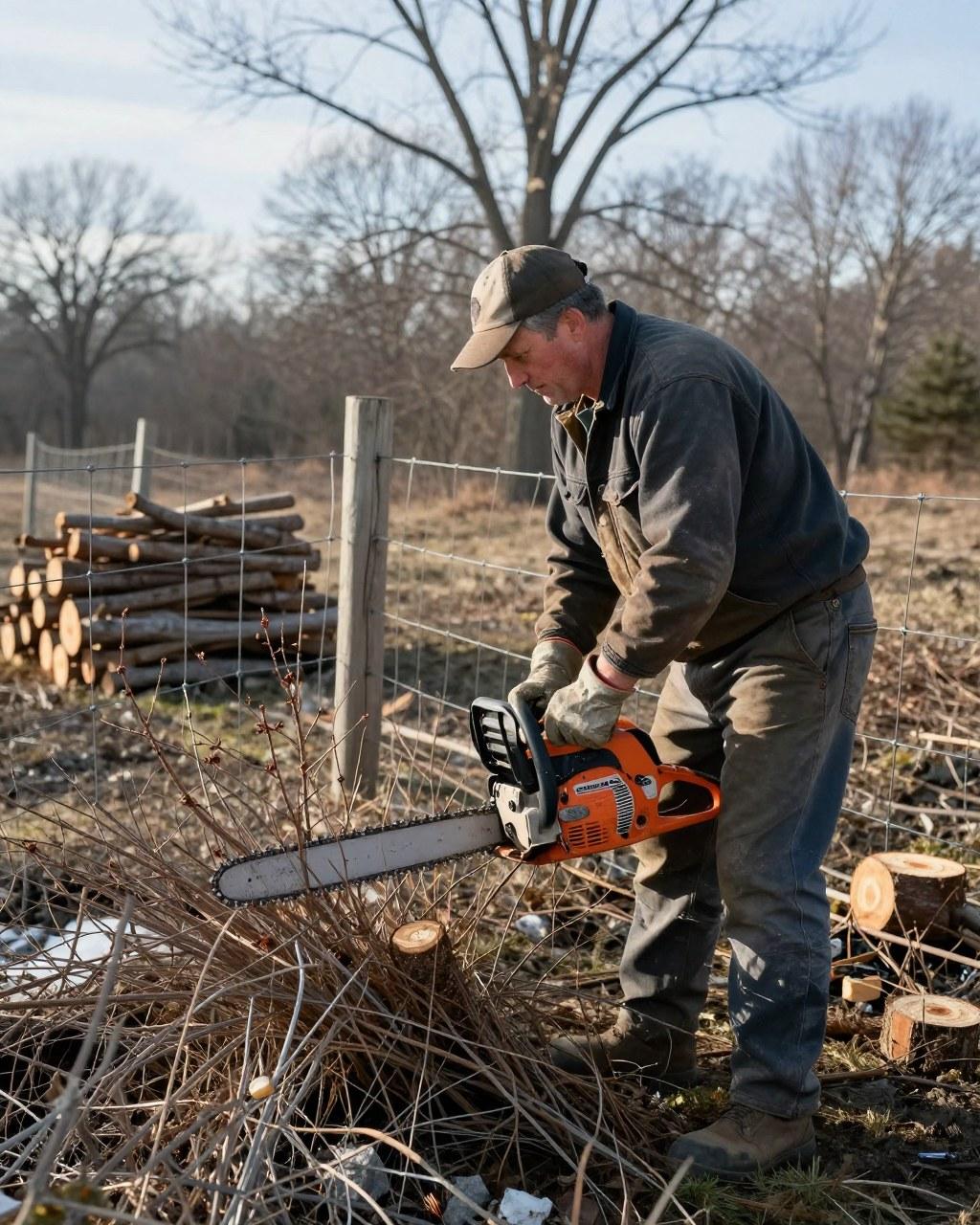
Dormant-season cutting stresses woody plants at their weakest point, so winter work tends to stick better than a summer trim. But the right window shifts with your climate and fence type.
How climate shifts the window
- Cold-winter regions: late winter, after the worst cold but before bud break, is ideal. The ground is firm enough for equipment, and cut stumps have less stored energy to push new growth.
- Mild-winter regions: dormancy is shorter and less pronounced. The practical window is often late fall through early spring, and fast growers may need a second pass in midsummer.
- Hot, dry regions: avoid midsummer cutting of woody plants, heat stress plus fresh cuts can kill desirable vegetation and leave bare soil exposed to erosion. Late fall or early spring is safer.
- Wet, humid regions: "dormant" may last only a few weeks. Plan on the annual pass plus at least one summer spot-clear for vines and briars.
Safety around electric fences, utilities, and wildlife
- Electric fence: shut off the charger before cutting anywhere near the wire. A string trimmer or metal blade contacting a live wire can shock the operator and damage the charger. Confirm the fence is off, then re-energize and test after clearing.
- Utilities: call 811 before any digging or stump work near a fence line. Overhead lines are a chainsaw hazard, keep poles and limbs well clear and never cut toward a line.
- Nesting season: many birds nest in fence-row brush from spring through midsummer. Do heavy clearing in late winter before nesting begins; if you must cut in season, check brush before cutting and leave active nests alone.
- Protective equipment: eye and ear protection, heavy gloves, long sleeves, and chainsaw chaps for any saw work. A reciprocating saw with an arbor blade is safer near wire because it has less kickback than a chainsaw.
The trade-off: winter visibility vs. summer regrowth
Winter clearing gives you visibility and firm ground, but cut stumps sit until spring and some species resprout vigorously once warm weather arrives. Summer clearing lets you see regrowth in real time and catch vines before they climb, but heat, insects, and nesting season make it slower and riskier.
If you're hiring out, timing matters for scheduling too. A professional crew stays busy in season, so book ahead. You can see what fence line clearing in East Texas involves and plan around the season.
Fence Line Clearing Equipment for the Job
Match the tool to the growth, not the other way around. A string trimmer handles weeds. It won't touch a two-inch sapling.
- String trimmer: grass and light weeds
- Brush cutter: thick weeds and briars
- Reciprocating saw with arbor blade: saplings and limbs near wire
- Chainsaw: trees and heavy woody vegetation
- Lopping shears: clean cuts on small branches
The wrong tool slows you down and damages fence wire.
Weighing a machine pass against doing it by hand? Our comparison of forestry mulching vs hand clearing for fence lines lays out cost, speed, and regrowth control side by side.
How to Keep Fence Lines Clear Between Full Clearings
Maintenance is what separates a cleared fence line from one that grows back by summer.
Walk the line each season and cut anything new. Spot-clear saplings while they're still thumb-thick. Pull vines before they climb the wire.
- Spring: cut new growth, check for storm damage
- Summer: spot-clear saplings and vines
- Fall: final trim before dormancy
For a concrete tool list and seasonal plan, see our guide on essential tools for maintaining cleared fence lines.
Watch out: clearing only your side leaves neighbor-side brush to seed your line next spring. Clear both sides where you can, or coordinate with the neighbor.
Fence line clearing is a job that rewards a schedule over a scramble.
Frequently Asked Questions
How often should you clear fence lines?
Most properties need a full clearing once a year, with spot checks every few months. Fast-growing areas with vines, saplings, and dense brush may need two passes a year. Slow-growing pastures with light weeds can stretch to every 18 to 24 months. Walk the line in early spring and late summer to see what has grown back, then decide whether a quick trim or a full clearing is needed.
What happens if you leave brush and vines on a fence?
Vines and brush trap moisture against posts and wire, which speeds up rust and rot. Overhanging branches drop limbs that bend or break top wires, and heavy growth hides damage until a fence fails. Brush also gives wildlife cover to push through and creates a fire fuel load along the boundary. A fence line you clear fence lines on regularly is easier to inspect and cheaper to repair.
How much does fence line clearing cost?
Fence line clearing cost depends on linear feet, brush density, terrain, and access. Dense saplings and mature trees take more machine time than weeds and light brush, so pricing varies by property. Pricing depends on the specifics of your property. For a current price or a quote, contact SemperFi Land Clearing LLC through its website.